What Are Kaomoji? Copy and Paste Guide (2026)
Kaomoji are Japanese text emoticons made from ordinary keyboard and Unicode characters, read face-on like (^_^) and ¯\_(ツ)_/¯. Copy one from the collection below and paste it into Discord, a social bio, or any chat. They are plain text, so they work anywhere text works.
A kaomoji is a face made of text. No image, no emoji keyboard, no app. Just characters arranged so they look like a face when you read them the right way up. The classic (^_^) is a smile. (T_T) is crying. ¯\_(ツ)_/¯ is a shrug.
Our site started as a text repeater, and the same copy-paste tricks power the text guides below. This post explains what kaomoji are, where they came from, and how they differ from emoji. Then comes the main part: a categorized collection to copy and paste.
What kaomoji are
Kaomoji (顔文字) is a Japanese word. It joins “kao” (顔), meaning face, and “moji” (文字), meaning character. The literal translation is “face characters”: faces made of characters.
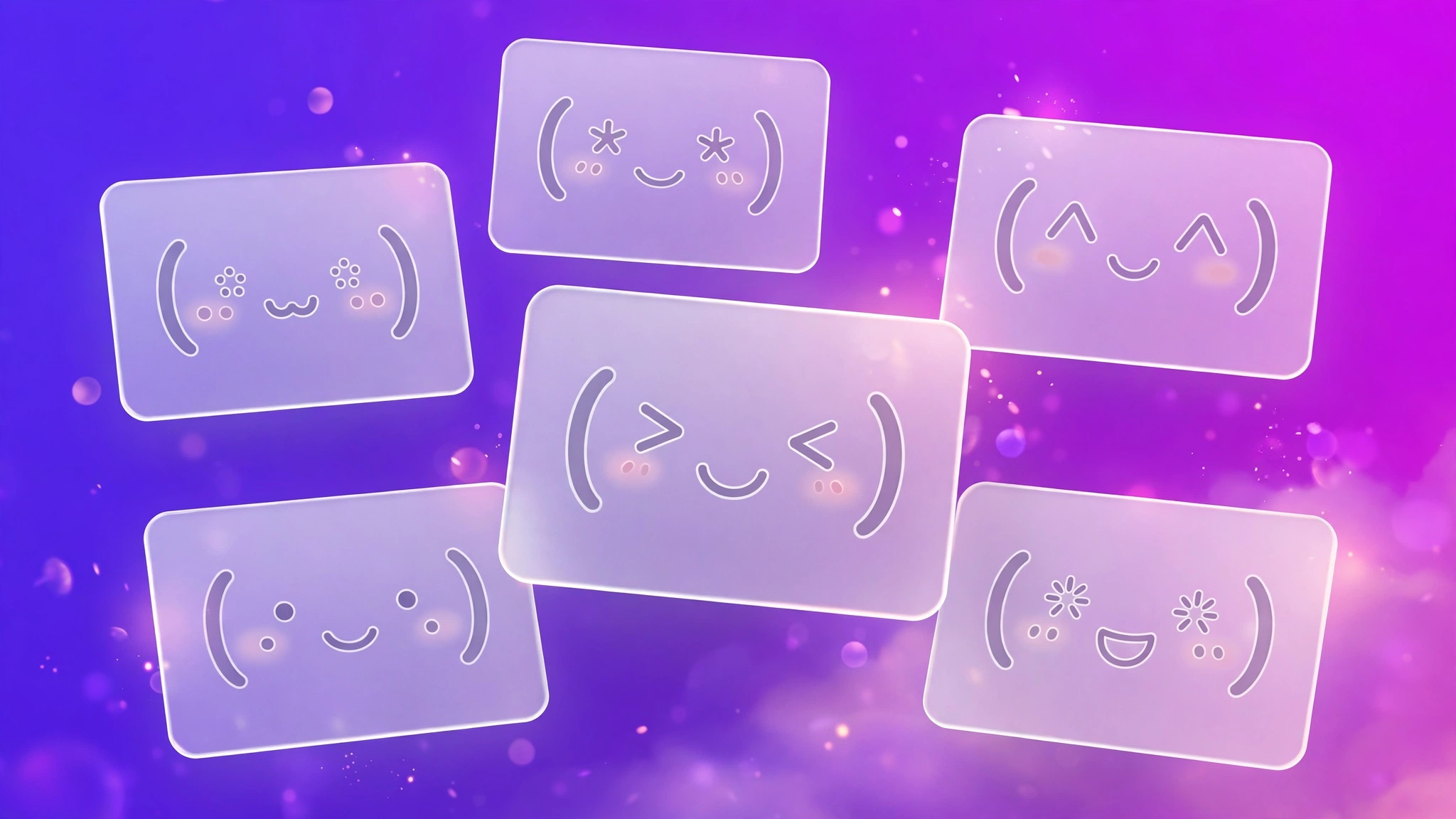
A kaomoji has three parts: eyes, a mouth, and a frame. The parentheses form the outline of the face. In (^_^), the carets are the eyes and the underscore is the mouth. Change the eyes and the mood changes. Swap the carets for T and you get (T_T), a crying face. Swap them for hearts and you get (♥_♥), a face in love. Some kaomoji add arms, like the shrug ¯\_(ツ)_/¯.
The eyes carry most of the meaning: closed happy eyes mean joy, T-shaped eyes mean tears, and wide round eyes mean shock. Kaomoji borrow characters from many writing systems: the shrug uses ツ, the Japanese katakana character for “tsu”, and the look of disapproval, ಠ_ಠ, uses a letter from Kannada, a language of southern India. There is no official list of kaomoji: anyone can invent a face.
A short history of kaomoji
Kaomoji first appeared in Japan in the 1980s, on ASCII NET, an early Japanese online service. Yasushi Wakabayashi is credited with the original kaomoji, (^_^), in 1986. Online messages were plain text then, with no images and no emoji. People needed a way to show tone, so they drew faces from the characters they had.
Kaomoji grew through the 1990s on Japanese forums, above all on 2channel (now 5channel), Japan’s largest anonymous message board, where users built more complex faces with the Shift JIS character set. The table flip, (╯°□°)╯︵ ┻━┻, spread through those boards before it reached the wider internet.
Western emoticons developed separately: Scott Fahlman proposed 🙂 and 🙁 on a Carnegie Mellon message board in 1982, but Western faces are read sideways, by tilting your head, while kaomoji are read face-on. Anime forums adopted kaomoji in the 2000s, and from there they spread into gaming chats and social media.
Kaomoji are also a precursor to emoji, which came later: in 1999, Shigetaka Kurita designed 176 small icons for NTT DoCoMo’s i-mode mobile service. Emoji turned that idea into a fixed, standardized set, while kaomoji stayed open and handmade: text only, with no fixed list.
Kaomoji vs emoji vs Western emoticons
The three look alike in a chat, but they work differently. An emoji is a picture your phone draws, so an iPhone smile and an Android smile are different images. A kaomoji is text, so (^_^) looks the same on both, and it pastes into places that reject emoji, like some usernames and chat fields that strip images.
| Feature | Kaomoji | Emoji | Western emoticon |
|---|---|---|---|
| Built from | Plain text characters | One pictograph, drawn as an image | Punctuation only, like 🙂 |
| Read | Face-on, no tilt | Face-on | Sideways, tilt your head |
| Looks the same everywhere | Yes, mostly | No, each platform draws its own | Yes |
| Can you invent new ones | Yes, anyone can | No, only Unicode adds them | Yes, but the range is small |
How to copy and paste a kaomoji
Copying a kaomoji is the same as copying any text. The hard part is typing one from scratch, because most keyboards lack characters like ツ or ಠ. That is why people copy instead of type. On a computer, highlight the kaomoji, then press Ctrl+C on Windows or Cmd+C on a Mac, and paste with Ctrl+V or Cmd+V. On a phone, long-press the kaomoji, tap Copy, then long-press the text field and tap Paste. Keep the whole face together: the shrug needs all nine characters, ¯\_(ツ)_/¯.
On Discord, watch the backslash: Discord’s markdown treats it as an escape character, so it can swallow the backslash in ¯\_(ツ)_/¯ in a message. Double the backslash before you send, so Discord shows one. Nicknames and bios do not parse markdown the same way, so the shrug usually pastes fine there.
For longer text art, build it in a tool first and then copy the result. The text art generator at https://quicktextrepeater.com/text-art-generator/ makes styled text for the same places kaomoji go: bios, usernames, and chats.
Where kaomoji work
Kaomoji work anywhere plain text works: Discord chats, server names, nicknames, and custom statuses; Instagram, TikTok, and X bios; WhatsApp and Telegram messages; YouTube and Reddit comments; and forum posts. They are best in short bursts: one at the end of a sentence adds tone, and one or two in a bio looks friendly. Ten in a row is hard to read and looks like spam.
Some places still reject them. A field that accepts only plain English letters will drop characters like ツ. If a face pastes as boxes or question marks, try a simpler face like (^_^) or (T_T). They fit casual text, not formal text.
Happy kaomoji to copy and paste
Happy faces use ^, ◕, or ω for eyes and an open mouth for a laugh.
| Kaomoji | Meaning |
|---|---|
| (^_^) | A smile, the classic kaomoji |
| (^▽^) | A big smile |
| (≧▽≦) | Laughing hard |
Love and cute kaomoji to copy and paste
Love faces use hearts for eyes or cheeks.
| Kaomoji | Meaning |
|---|---|
| (♥ω♥) | Heart eyes, in love |
| ♥‿♥ | Love-struck |
| (♡‿♡) | In love |
Sad and crying kaomoji to copy and paste
Sad faces use T or ; for tears.
| Kaomoji | Meaning |
|---|---|
| (T_T) | Crying |
| (ToT) | Crying |
| (;_;) | Sad, with tears |
| (╥﹏╥) | Crying hard |
Angry and annoyed kaomoji to copy and paste
Angry faces use sharp eyes and a glare.
| Kaomoji | Meaning |
|---|---|
| (╬ಠ益ಠ) | Furious, glaring |
| (#`Д´) | Angry, shouting |
| (ノಠ益ಠ)ノ | Angry, about to flip something |
| ಠ_ಠ | The look of disapproval |
Surprised and confused kaomoji to copy and paste
Surprised faces use wide round eyes.
| Kaomoji | Meaning |
|---|---|
| (O_O) | Shocked, wide-eyed |
| o_O | Confused, one eye raised |
| (⊙_⊙) | Staring in surprise |
| (゚Д゚) | Startled |
Shrug kaomoji to copy and paste
The shrug means “I do not know” or “oh well”.
| Kaomoji | Meaning |
|---|---|
| ¯\_(ツ)_/¯ | A shrug, “I do not know” |
| ┐(´~`;)┌ | An exasperated shrug |
| ┐(°‿°)┌ | A shrug |
| ¯\_(-.-)_/¯ | A deadpan shrug |
Table flip, Lenny face, and other famous kaomoji
A few kaomoji became memes on their own. The table flip shows rage by flipping a table, and the Lenny face is a smug, knowing look from Western meme culture.
| Kaomoji | Meaning |
|---|---|
| (╯°□°)╯︵ ┻━┻ | Flipping a table in anger |
| ┬─┬ノ(º_ºノ) | Putting the table back |
| ( ͡° ͜ʖ ͡°) | The Lenny face, smug and knowing |
How to make your own kaomoji
Start from a face you know and change one part at a time: pick the eyes for the feeling (^ for happy, T for crying, ♥ for love, O for shock), then the mouth (_ for a smile, ω for a laugh, ﹏ for a sad wobble), then the frame. Parentheses are the safe default; add arms with / and \ or raised hands like ヽ and ノ. If the feeling is not clear in one second, change the eyes first, and keep it short: the most used kaomoji are five to nine characters long.
Mistakes to avoid with kaomoji
The most common mistake is pasting half a face. Always copy the full string, brackets and arms included, and check the result after pasting. The second mistake is using a rare character in a place that cannot show it: faces built from common characters, like (^_^), (T_T), and ¯\_(ツ)_/¯, work almost everywhere, so swap a broken face for a simpler one. The third mistake is the Discord backslash: if ¯\_(ツ)_/¯ loses its backslash in a message, double the backslash before sending. The fourth mistake is overuse. One kaomoji adds tone; five in one sentence bury the sentence. The fifth mistake is using the wrong mood: the Lenny face reads as smug, and the table flip reads as rage, even as a joke.
When to use kaomoji, and when to use emoji
Use kaomoji when you want a tone that emoji cannot give: a shrug, a deadpan stare, or a face that fits inside a username. Use them where emoji are blocked, like a plain-text field, and when you want your message to look the same on every device. Use emoji when you want color and a picture, like a red heart, or when the reader may not know kaomoji: everyone knows a smiling emoji, but not everyone knows what orz means.
FAQ
What is a kaomoji?
A kaomoji is a Japanese text emoticon made from ordinary keyboard and Unicode characters, read face-on. The word joins “kao” (face) and “moji” (character).
How do I copy and paste a kaomoji?
Highlight the kaomoji, copy it with Ctrl+C on Windows or Cmd+C on a Mac, then paste it with Ctrl+V or Cmd+V. On a phone, long-press the kaomoji, tap Copy, then long-press the text field and tap Paste.
What is the difference between kaomoji and emoji?
Kaomoji are plain text characters and look the same on every device. Emoji are single Unicode pictographs that each platform draws as its own colored image, so the same emoji looks different on iPhone and Android. Anyone can invent a kaomoji, while new emoji are added only through the Unicode standard.
Why does the shrug kaomoji break on Discord?
The shrug, ¯\_(ツ)_/¯, contains a backslash, and Discord’s markdown treats a backslash as an escape character, so it can swallow the backslash in a message. Double the backslash before you send the message and Discord will show one.
Where can I use kaomoji?
You can use kaomoji in Discord chats, nicknames, and bios; Instagram, TikTok, and X bios; WhatsApp and Telegram messages; YouTube and Reddit comments; and forum posts. They do not suit formal text, and some strict fields that accept only plain English letters will reject them.